
Everything feels wrong
Blue Velvet in 2025

Everything feels wrong — Blue Velvet in 2025
RIP David Lynch, a singular artist, where singular doesn’t just mean ‘really good’, but singular. The way he photographed objects, the words he made his actors say, were choices of a man whose mental life must have been utterly different from my own. Part of that is a consequence of history, of course — Lynch came of age in the classic era, peak Americana with the diners and the crooning, that mythological time where everything important happened all at once; and the other part of it is the contingent weirdness of Lynch as a man, the weirdo factor which it feels like we can’t account for anymore.
I went to a screening of Blue Velvet last night at the Lubber Fiend, with Oscar Jelley. The venue was packed with goths, old blokes and normal people, which was nice. I was in a giddy mood going in, because I had a beer on the Metro there. For a while, my mood stayed giddy, because this film has moments which make you hoot with laughter. Kyle MacLachlan plays a character called Jeffrey Beaumont, a college student who oscillates between simple goof-maxing and a kind of grim silent seriousness. Since MacLachlan can’t exactly ‘act’ very well in the traditional sense, objectively silly moments like him demonstrating his ‘chicken walk’ to Laura Dern take on a dreamlike quality, because it’s so non-natural, yet you get the impression that this is Lynch’s sincere depiction of how a young man in a small town would court a young woman. For Lynch, non-natural whimsy is baked into small town Americana, it’s the artificial diamond that his heroes fight to preserve.
Of course, things darken. Jeffrey Beaumont stumbles into some sort of crime narrative. The crime story isn’t exactly complicated, but it doesn’t feel like a comprehensible reality either. Lynch plops the facts of the matter right in front of you — there’s a narcotised jazz singer (Isabella Rossellini as Dorothy), there’s a crime ring led by Frank (Dennis Hopper), and he’s kidnapped her children and husband in order to sexually abuse her. But Frank isn’t a criminal from the real world. He swears wrongly — saying “fuck” instead of fucker, like, Come here fuck! I know you’re in there!. Music affects him more than it should, sending him into reveries, unconsciously mouthing the lyrics like his consciousness has been hijacked by old crooners.
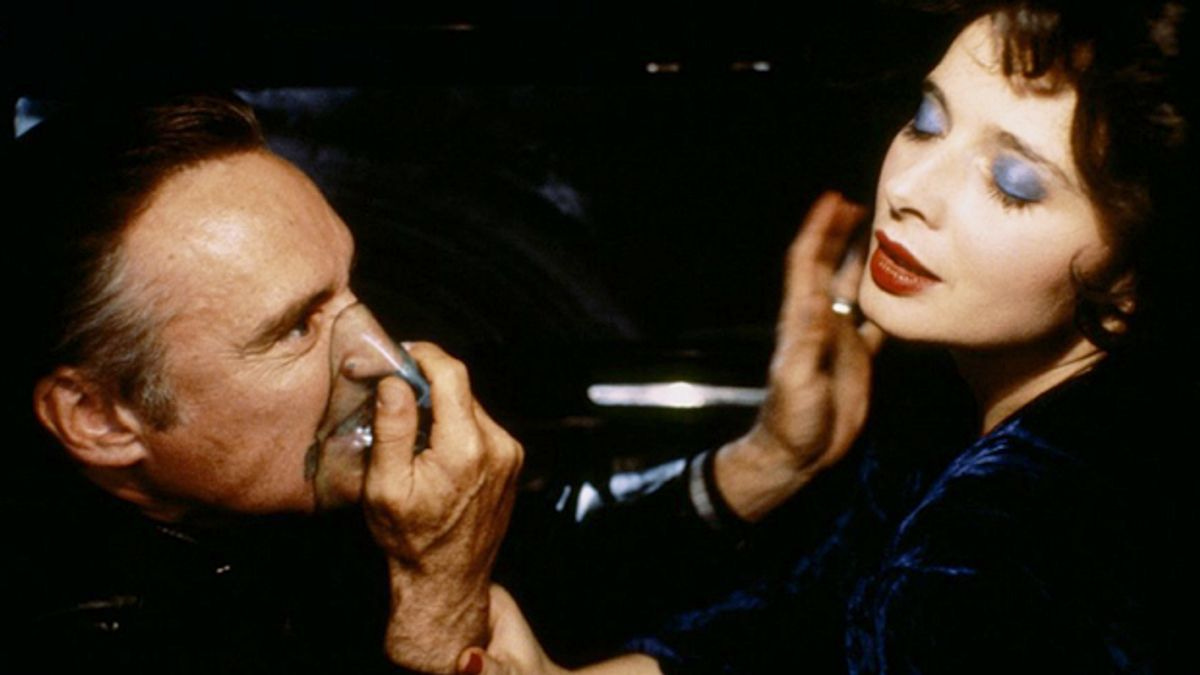
During his first encounter with Dorothy, he begins in machismo crime-boss mode, demanding bourbon, telling her to spread her legs… but then he retrieves a gas mask, inhales from it, and starts wailing MOMMY, eyes rolling towards the ceiling, regressing into an infantile state, but still managing to assault her. What substance could he have been huffing? What can we infer about his life, or his childhood, from the way he acts when he’s on the gas? Jeffrey’s watching from the wardrobe, peeping through the hole, an accidental(?) voyeur. How could such impenetrable darkness be occurring in an apartment room yards from the cherry-pie Americana which is his natural home?
She wore blue velvet, but in my heart there'll always be
Precious and warm a memory through the years
And I still can see blue velvet through my tears
Later in the film, Frank drags Jeffrey and Dorothy to the apartment of ‘Ben’, a gay-seeming vaguely criminal guy who looks like he’s wearing white foundation and lip liner. Dorothy is ushered into a door where her husband and children are being kept (and tortured?); the camera doesn’t follow her through the threshold, we only hear her sobs. The room feels evil. The plush redness of the armchairs, the muted horrors of the carpet, the older women sat smoking outside the room where the horrors are occurring… this is something Lynch did exceptionally well. He could film an object or a room or a person, and make it just hum with malice, the demon in the motel room, a scene where nothing’s out of place but everything feels so wrong.
In the room where everything feels so wrong, Ben drops the needle on In Dreams by Roy Orbison, which Frank experiences with a kind of transcendental intensity. Ben lip-syncs like cabaret, mouthing into a toy mic, batting sad eyes at the criminals and hostages assembled inside the evil apartment room. It’s too much for Frank, he starts shaking, and Ben has to hurriedly turn it off. You get the feeling that this is a regular thing for Frank and his gang, this lip-sync a kind of comforting ritual for them. And again you get this feeling of regression from Frank, like the music evokes memories which are too veridical, too saturated, they overload his brain and make him want to kill.
Jeffrey and his girl end up winning in Blue Velvet, of course. David Lynch was a Manichean filmmaker. All of his films are intense spiritual battles between the blinding white goodness of love and lightness, versus an overwhelming blackness beneath the topsoil of beloved American towns. To modern people in Britain, which is to say, to me, Lynch’s ‘ying’ depictions of spiritual bliss feel equally as haunting as his celebrated ‘yang’ depictions of surreal darkness. How can you ease back into small-town life if it’s populated by candy-coloured clowns, holed up in apartment rooms with evil carpets? But this is why people like me venerate Lynch — his films depict a world which is even more saturated with incomprehensibility and darkness than our own, and yet his stilted small town Americans usually prevail, at least for now. The way the criminal gang just sort of melts away, the dad recovers from his heart attack… if it sounds like wish fulfilment, that’s because it is; dreams are pictorial representations of wishes, and a David Lynch film is a reconstruction of a collective dream.